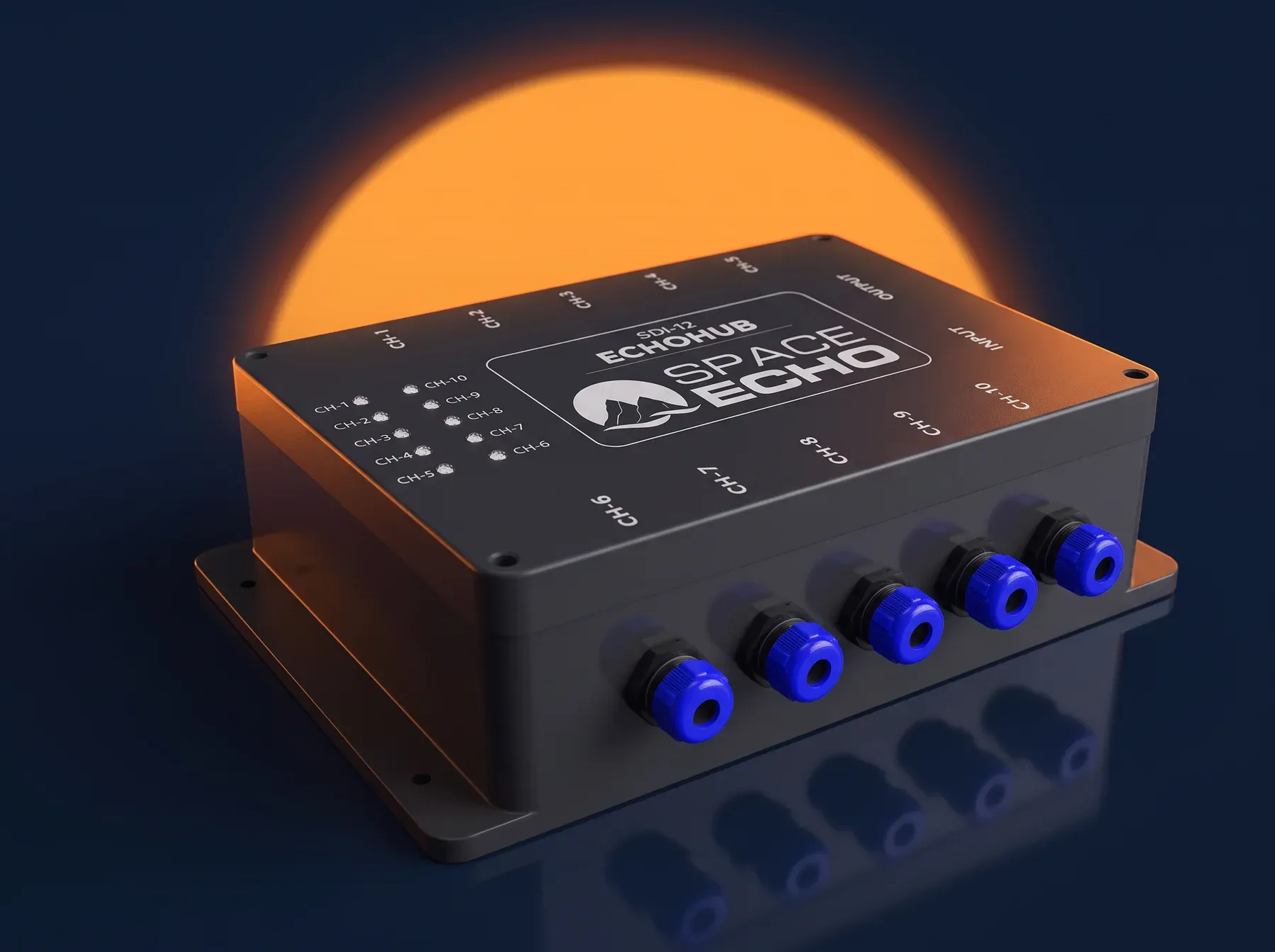
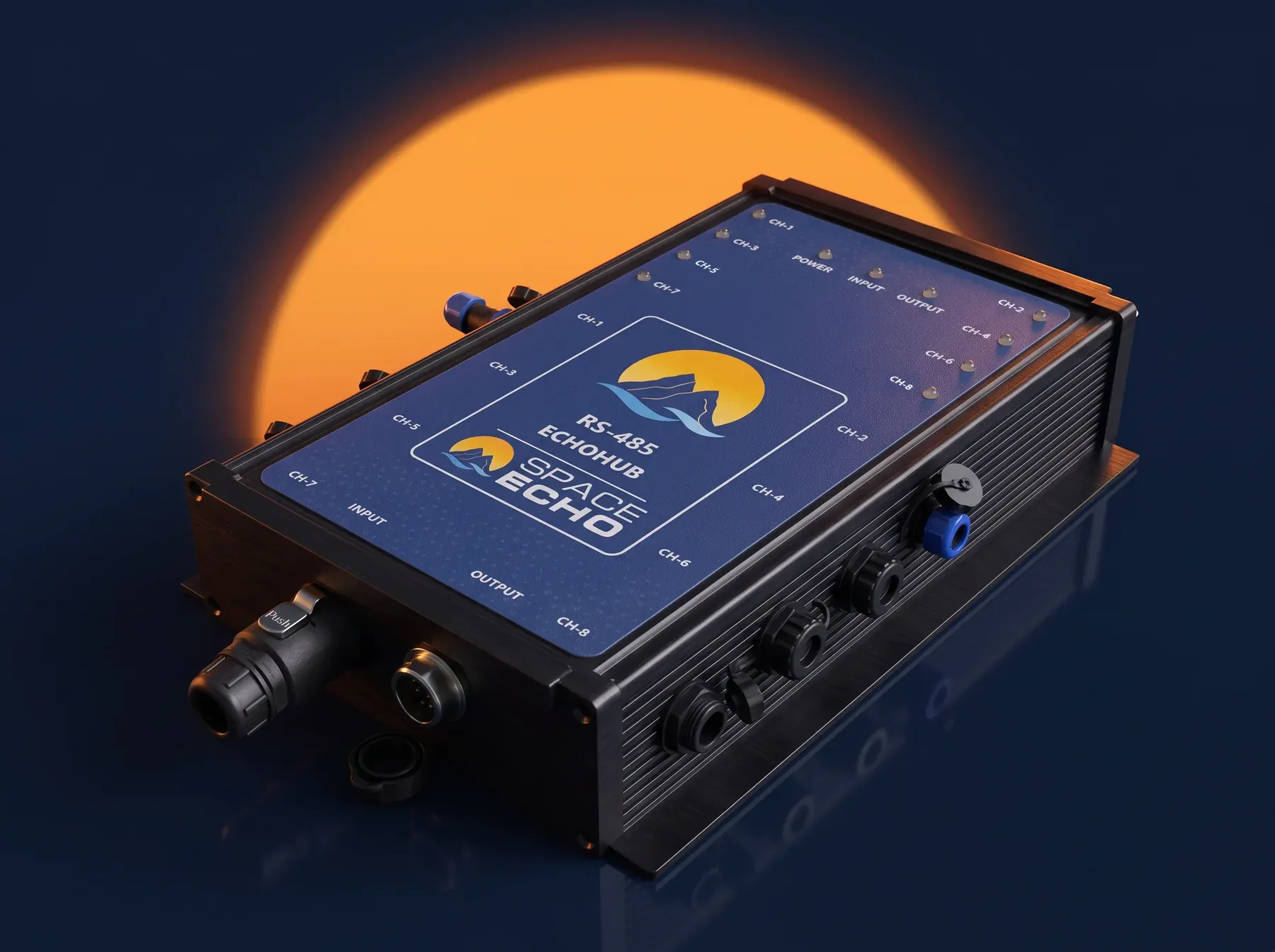

IP67 sensor expansion hub for the ECHO-Gateway, designed and made by SpaceEcho
EchoHub-485
An IP67 RS-485 hub that gives the ECHO-Gateway 8 sensor ports, and up to 32 ports with 4 daisy-chained hubs. I...
IoT gateway and data logger, designed and made by SpaceEcho
SpaceEcho's flagship IoT gateway and data logger: 4G and Ethernet with automatic failover, no data lost in an outage, and up to 32 sensor ports with 4 EchoHub-485 units.
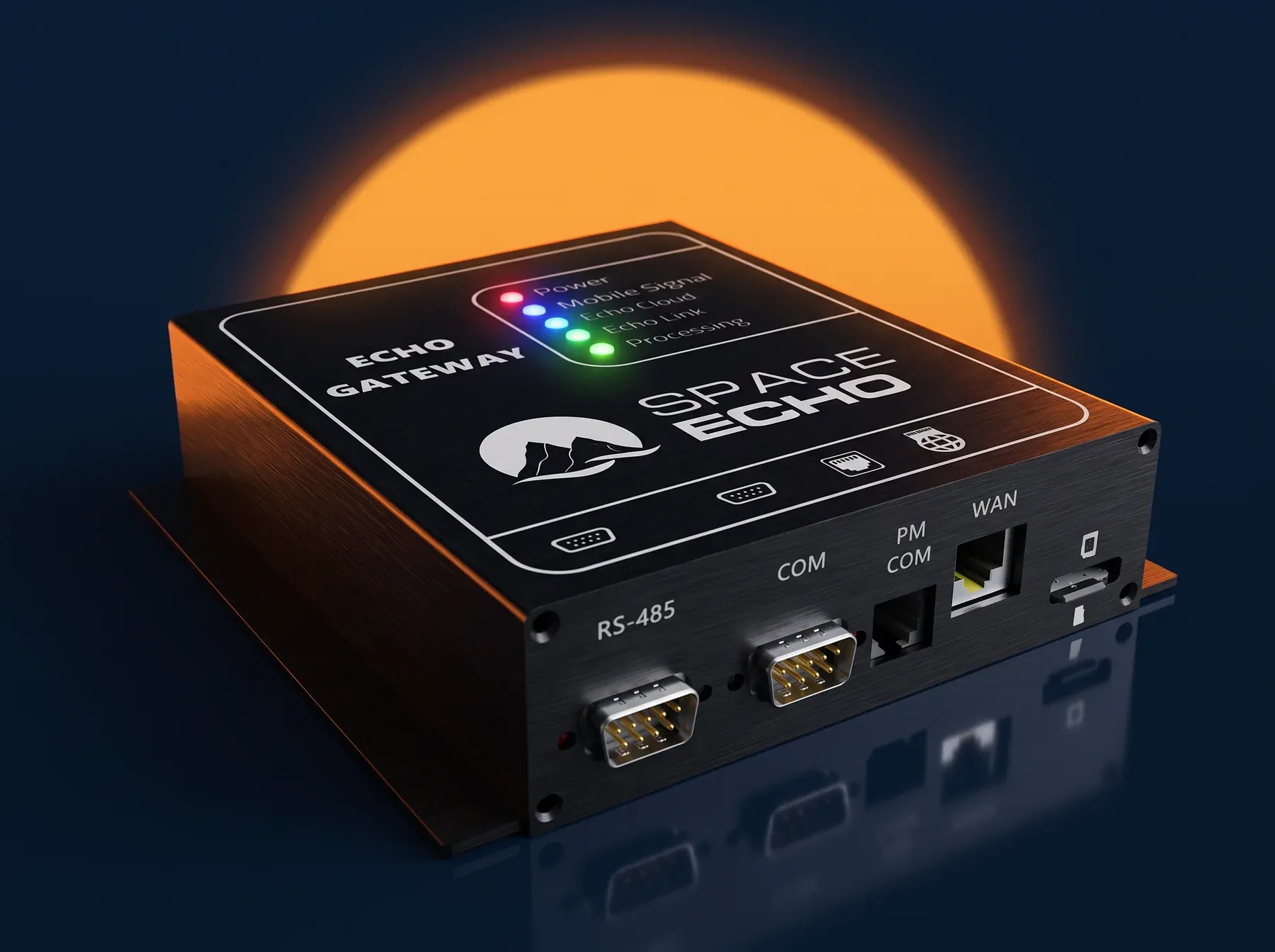
The ECHO-Gateway v4 is SpaceEcho's flagship IoT gateway and data logger, designed and manufactured by SpaceEcho. It is the core of every SpaceEcho station: it collects sensor data, stores it on site, and sends it to EchoCloud over the network available at the site. It is built for remote and harsh locations, including off-grid sites running on solar power.
The gateway is the link between the field and the server. It has one sensor port. Connect an EchoHub-485 and it has 8. Up to 4 hubs can be daisy-chained, for 32 ports and 120 readings. The hub takes RS-485 sensors. The same gateway serves different applications, so one device type runs across a whole monitoring network.
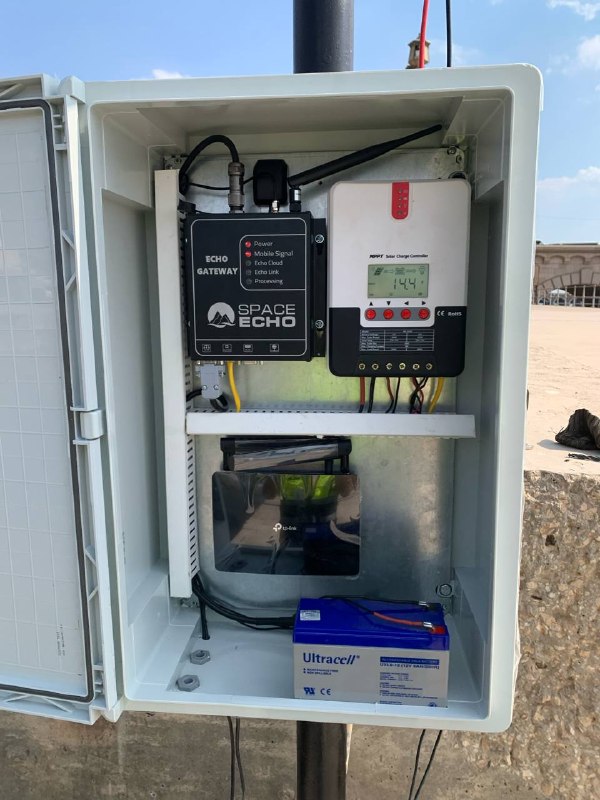
The gateway reports its own condition as well as the sensor data, so a problem can be seen and handled remotely.
The ECHO-Gateway v4 runs on an AC/DC adapter, a battery or solar power, alone or together, through a dedicated Power Control Unit. It also runs from any DC source without the unit, but charger and battery monitoring then stops.
| Input voltage | 12–36 V DC |
|---|---|
| Power consumption, gateway | About 2 W average, depending on enabled features |
| Power consumption, complete station | 15 W typical, 24 W peak |
| Power sources | AC/DC adapter, battery, solar |
| Protection | Short circuit, reverse polarity, over-voltage, under-voltage, battery over-charge, ESD, EFT |
| Sensor ports | 1 on the gateway; 8 with one EchoHub-485; 32 with 4 hubs (120 readings) |
| M2M protocols | MQTT, HTTP, Modbus |
| Connectivity | Ethernet; 4G; Wi-Fi 802.11 b/g/n |
| Failover | Automatic between 4G and Ethernet; data stored and resent after an outage |
| Ports | RS-485, RS-232, Ethernet RJ45, Power Control Unit RJ12, microSD slot, antenna |
| Storage | 3 microSD cards |
| Network services | Remote management through EchoCloud, FTP on-site data download, NTP time sync, VPN on request |
| Alerts | EchoCloud, Telegram |
| LED indicators | Power, Mobile Signal, Echo Cloud, Echo Link, Processing |
| Operating temperature | 10–70 °C |
| Storage temperature | −10–85 °C |
| Dimensions | 154 × 158 × 39 mm |
| Weight | 300 g |
| Material | Aluminium |
| Mounting | Panel |
SpaceEcho offers installation, maintenance, calibration and repair of sensors and loggers, along with consulting, programming, EchoCloud customisation and practical training.
IP67 sensor expansion hub for the ECHO-Gateway, designed and made by SpaceEcho
An IP67 RS-485 hub that gives the ECHO-Gateway 8 sensor ports, and up to 32 ports with 4 daisy-chained hubs. I...
Outdoor signal converter to RS-485, from SpaceEcho
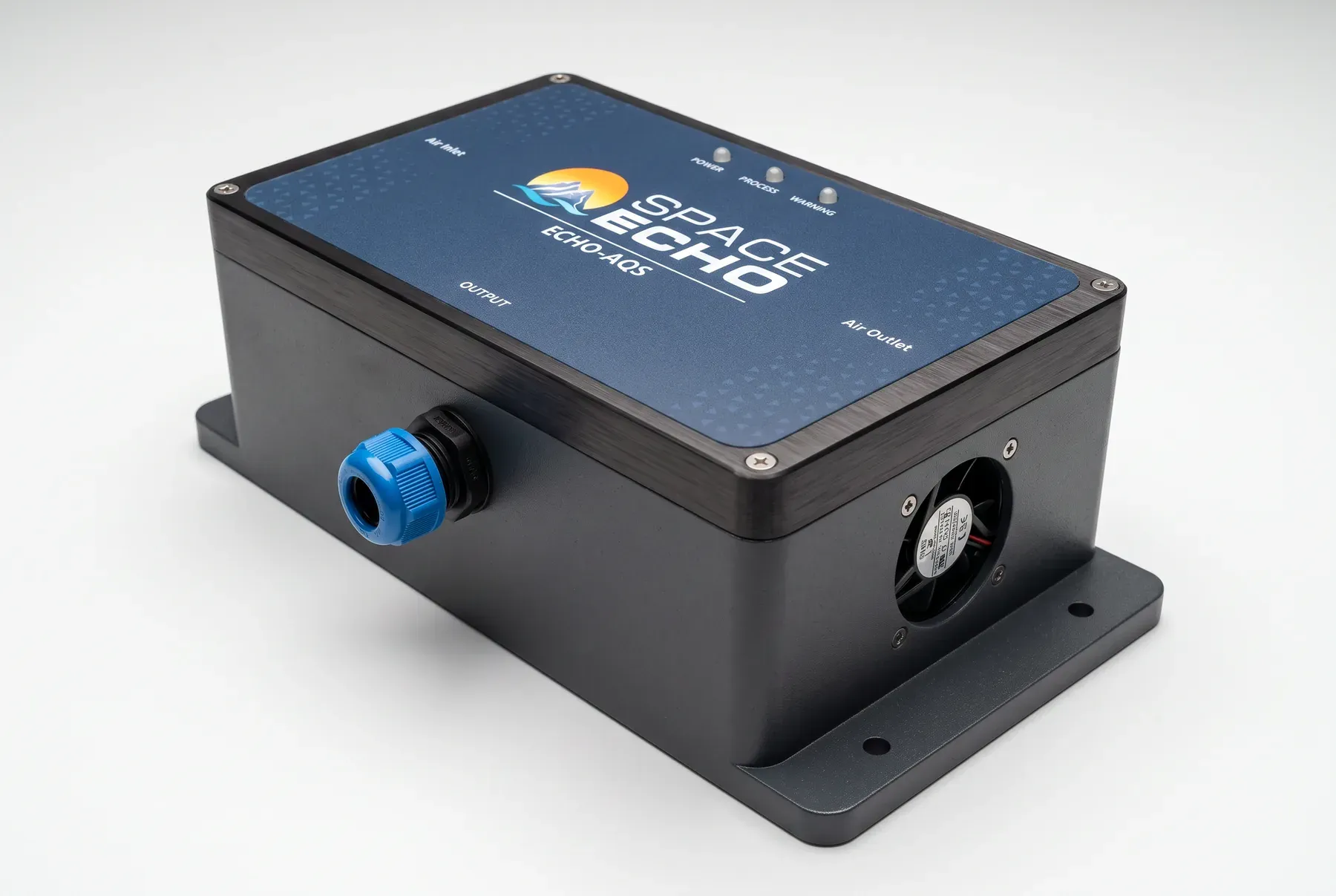
An IP67 outdoor converter that turns 0–10 V, 4–20 mA or SDI-12 sensor signals into RS-485, for the ECHO-Gatewa...
Model: AQS
Continuous monitoring of CO, CO₂, NO₂, SO₂, O₃ and NH₃, with temperature and atmospheric pressure.
Yes. The gateway is the link between the field and the server, so it works with any sensor SpaceEcho supports and provides.
It is ready to run, but no sensors are set up at first launch. Connect through RS-232 and configure them with the ECHO-Configurator in EchoCloud.
The gateway has one sensor port. An EchoHub-485 gives it 8, and 4 daisy-chained hubs give it 32 ports and 120 readings.
Yes. It runs from any DC source, but charger and battery monitoring stops.
With 4G and Ethernet, the gateway restores communication over the other link. If all communication is down, it keeps the data and resends it when the connection returns.
Request a Quote
Working with





Request received
Thanks — our team will contact you shortly.